What Documents Must Immigrants Carry for ICE Under the New Registration Rule?







Posted on 07/04/26 at 17:09
- New registration rule is now in effect.
- DHS defines exemptions.
- Immigration registration requirements updated.
The new final rule on alien registration took effect on June 29, updating the procedures that certain noncitizens in the United States must follow.
- Why it matters: Federal law requires registered noncitizens who are 18 years of age or older to carry valid proof of registration at all times. Failing to do so may constitute a misdemeanor punishable by law.
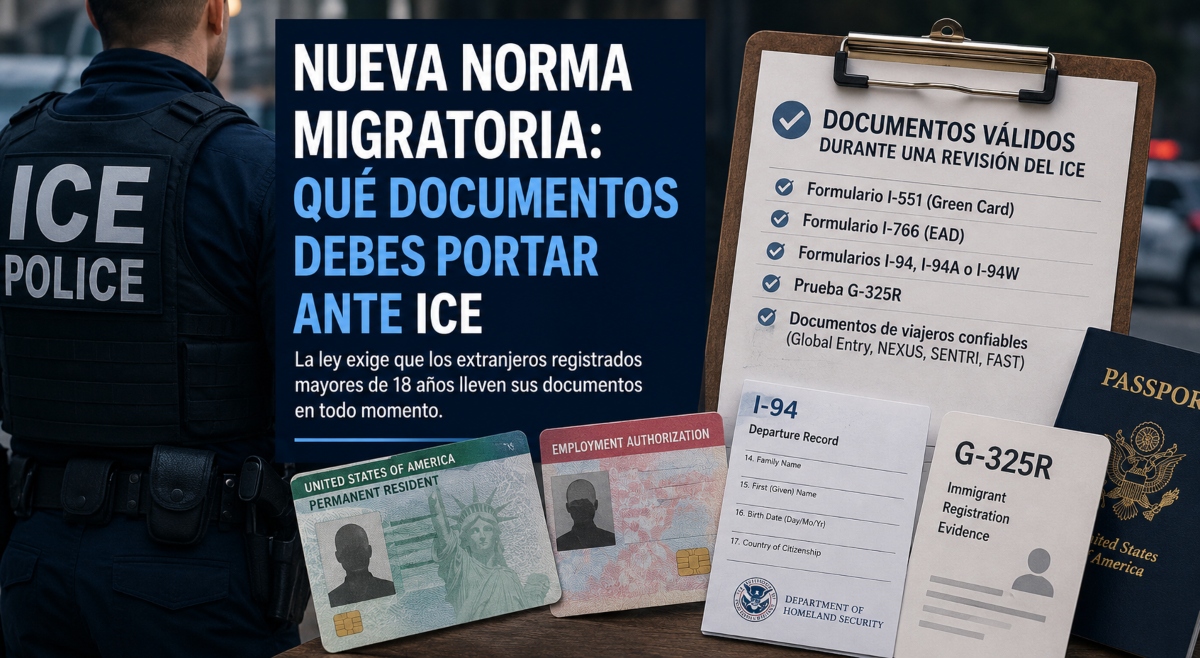
The updated regulation also specifies which documents are considered valid during an inspection conducted by U.S. Immigration and Customs Enforcement (ICE).
Under the rule, every registered noncitizen aged 18 or older must carry their Certificate of Alien Registration or registration receipt card at all times.
Failure to carry the required document may result in fines or even a jail sentence of up to 30 days.
What Documents Are Valid During an ICE Inspection?

Accepted ICE registration documents include Form I-551, better known as the Permanent Resident Card, or Green Card.
Form I-766, the Employment Authorization Document (EAD), is also considered valid.
The list also includes Forms I-94, I-94A, and I-94W, which serve as official records of admission to and departure from the United States.
YOU MAY ALSO LIKE: DHS Tightens Immigration Rules: Millions May Be Required to Register or Face Penalties
The new immigration rule also recognizes the G-325R proof of registration.
This electronic form was created by U.S. Citizenship and Immigration Services (USCIS) as part of the updated alien registration process.
Another category of acceptable documentation includes credentials issued through Trusted Traveler Programs.
These include identification approved by U.S. Customs and Border Protection (CBP) for the following programs:
- Global Entry
- NEXUS
- SENTRI
- FAST
Who Is Exempt From Registration or Fingerprinting?

The Immigration and Nationality Act (INA) establishes exemptions for certain groups.
Department of Homeland Security (DHS) regulations also outline these exceptions.
The rule distinguishes between individuals who are exempt from registration entirely and those who must register but are not required to provide fingerprints.
Those exempt from registration include:
- U.S. citizens.
- Foreign government officials holding A or G visas.
- American Indians born in Canada.
- Members of the Texas Band of Kickapoo Indians.
- Foreign nationals who already completed registration during the consular visa application process.
Individuals in the final category are not required to register again under the new rule.
Who Is Not Required to Provide Fingerprints?
The new registration rule also establishes specific exemptions from fingerprint collection, even for individuals who must complete the registration process.
Children under the age of 14 are exempt.
However, once they turn 14, they must complete the registration process within 30 days.
Certain diplomatic visa holders are also exempt.
The list includes NATO-1 through NATO-6 visa holders.
The regulation also applies exemptions to citizens of countries covered by reciprocity agreements.
Additional exceptions exist for certain nonimmigrants, including individuals who remain in the United States for less than one year.
Canadian visitors entering the United States by land under specific conditions are also generally exempt from fingerprinting.
The new rule continues to distinguish between registration requirements and biometric identification requirements.
As a result, exemptions depend on each person’s immigration category and the conditions established under current federal law.