ICE Uses Fake Towers to Track Migrants’ Phones in the U.S.







Posted on 06/10/26 at 13:56
- ICE Tracks Mobile Phones
- Immigration Surveillance Questioned
- Protocol Failures Acknowledged
The mass deportation strategy promoted by President Donald Trump has once again placed some of the tools used by immigration authorities under scrutiny.
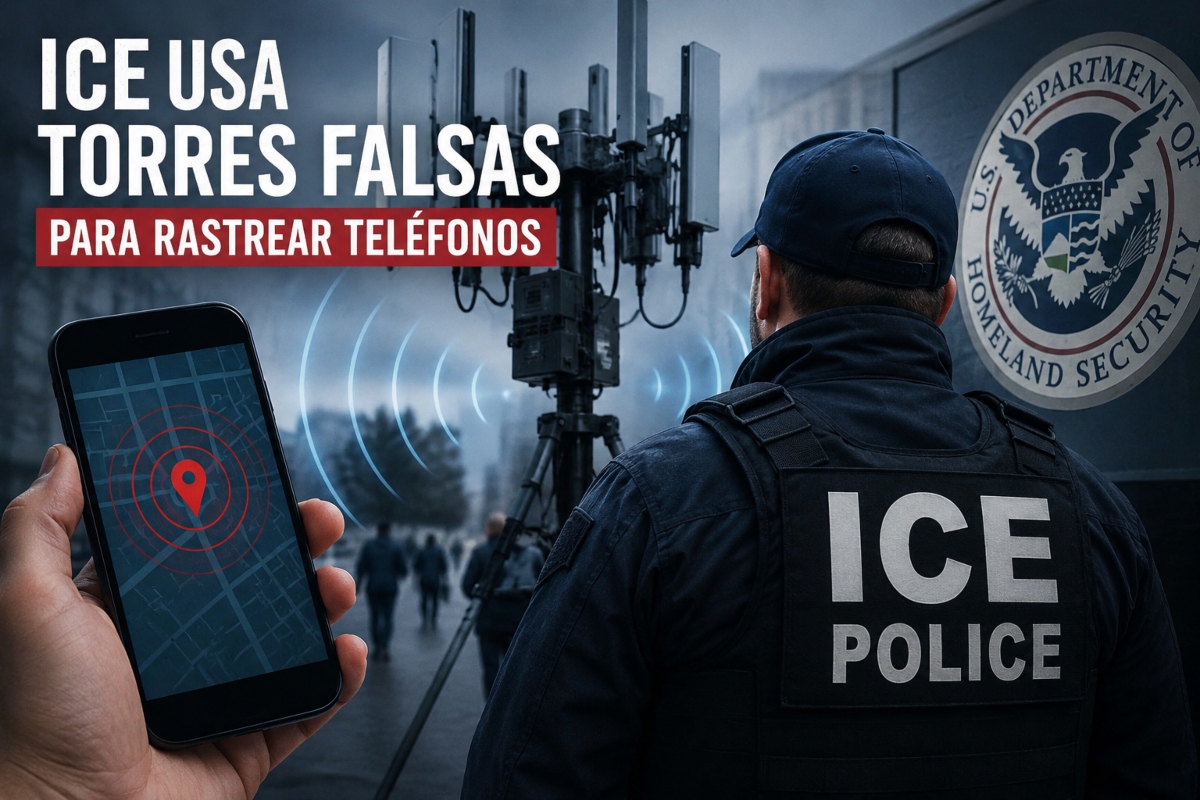
Among them are cell-site simulators, a technology that makes it possible to locate mobile phones through devices that imitate cellphone towers.
The practice has been questioned for years by privacy experts and organizations that defend migrants’ rights.
In addition, official documents acknowledged that, in certain cases, not all established protocols for the use of this technology were followed.
ICE Phone Tracking With Fake Towers
The new ways ICE can track migrants in the U.S.: how it locates phones with fake towers https://t.co/DV9ERN9YjK
— LaAlamedaMigrante (@LaAlamedaMigra) June 9, 2026
Agents with Immigration and Customs Enforcement, or ICE, began using cell-site simulators several years ago under a policy defined by the Department of Homeland Security, or DHS.
According to that document, the technology works through devices that imitate cellphone towers, according to La Nación.
Nearby phones automatically connect to these signals, allowing agents to identify and track specific devices.
The system makes it possible to determine the location of certain targets with precision.
It can also access device identifiers belonging to people who are not part of an investigation.
According to a report by the American Civil Liberties Union, or ACLU, simulators can reveal the identity of all phones located within a specific area.
YOU MAY BE INTERESTED IN: The ICE custody death of an immigrant in Louisiana raised the number of deaths recorded this year to 19.
However, DHS policy maintains that these tools only provide information related to signal strength and the general direction of a device.
Authorities also said the simulators cannot collect the content of communications.
This means they do not have the ability to access emails, text messages, contact lists, or images stored on phones.
Inspector General Detected Failures to Follow Internal Protocols
Although DHS established specific rules for the use of this technology, the Inspector General recently acknowledged that some agency components did not always follow those procedures.
An internal document indicated that both the Secret Service and ICE’s Homeland Security Investigations office, or HSI, at times failed to comply with federal statutes and internal policies during criminal investigations.
The irregularities were detected especially in situations considered urgent.
Authorities specified that both agencies did obtain search warrants in the cases reviewed.
However, in some files they did not request the court orders required under the Pen Register Act.
The report also concluded that HSI failed to comply with the E-Government Act of 2002.
That rule requires an approved Privacy Impact Assessment, or PIA, before using this type of technology.
According to authorities, resource limitations and personnel changes caused the agency to operate without an approved PIA until January 2022.
As a result, it was not possible to identify or previously mitigate some risks related to the privacy of the data collected.
Experts Warn of Privacy and Surveillance Risks
The use of cell-site simulators has again raised concern among digital rights specialists.
Chris Weiland, president of Restore the 4th Minnesota, said in statements to Sahan Journal that the use of this data without court orders may be considered a violation of the Fourth Amendment to the U.S. Constitution.
That provision protects people against unreasonable searches and seizures.
Weiland also warned that potential system errors could worsen when there is not enough diligence in implementation.
Experts also noted that questions remain about how collected data is stored and how it may later be used.
For his part, Cooper Quintin, senior technologist at the Electronic Frontier Foundation, expressed concern about the existence of agencies with advanced surveillance tools.
According to Quintin, the presence of agencies he considers problematic and that have access to this type of technology should be a cause for concern for the entire population.